

Back in 2015/16, everyone on London underground was reading this book. Well at least everyone that reads a book during commute, instead of smoking their phone.
I finally got around to reading it and finished it just today.
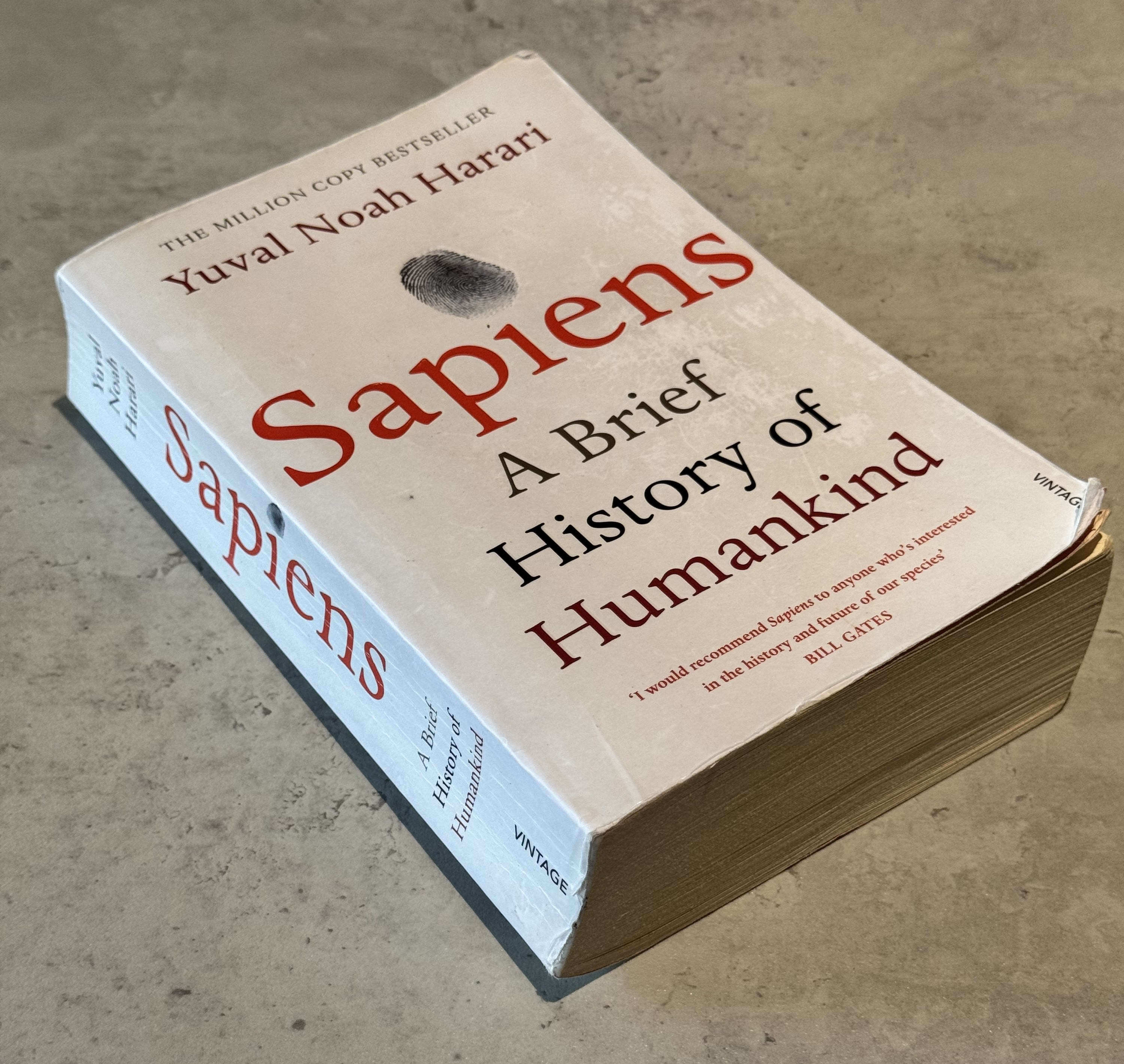
Absolutely loved the book. Yuval Harari walks us through human evolution, from a species that was thinly spread across the globe divided into small tribes, with barely any advantage over other animals. Hunting and gathering for their immediate needs, hardly thinking of survival beyond the next day. To a species that learned to farm, developed agricultural methods, domesticating both plants and animals, and in the process, also domesticated itself. Harari actually questions whether it was us domesticating our food, or our food domesticating us. A valid question.
The book is too long. So can’t summarise all of it. But, the scariest bits of the book are at the very end. Whilst you should read the complete book — it won’t be a bad idea to switch to the very last few sections and start with those, before reading it from the beginning.
I give you a few excerpts from the last sections:
Physicists define the Big Bang as a singularity. It is a point at which all the known laws of nature did not exist. Time too did not exist. It is thus meaningless to say that anything existed ‘before the Big Bang. We may be fast approaching a new singularity, when all the concepts that give meaning to our world - me, you, men, women, love and hate - will become irrelevant. Anything happening beyond that point is meaningless to us.
The Frankenstein myth confronts Homo sapiens with the fact that the last days are fast approaching. Unless some nuclear or ecological catastrophe intervenes, so goes the story, the pace of technological development will soon lead to the replacement of Homo sapiens by completely different beings who possess not only different physiques, but also very different cognitive and emotional worlds. This is something most Sapiens find extremely disconcerting. We like to believe that in the future people just like us will travel from planet to planet in fast spaceships. We don’t like to contemplate the possibility that in the future, beings with emotions and identities like ours will no longer exist, and our place will be taken by alien life forms whose abilities dwarf our own.
We are more powerful than ever before, but have very little idea what to do with all that power. Worse still, humans seem to be more irresponsible than ever. Self-made gods with only the laws of physics to keep us company, we are accountable to no one. We are consequently wreaking havoc on our fellow animals and on the surrounding ecosystem, seeking little more than our own comfort and amusement, yet never finding satisfaction.
Is there anything more dangerous than dissatisfied and irresponsible gods who don’t know what they want?
Sapiens came out before ChatGPT and the rest of the LLMs came into limelight the way they have now. And what Harari wrote in 2011 seemed like a distant possibility back then. In 2026, it seems like we are fast approaching what he predicted with scary certainty. Having just finished this book, I am getting a fresh new appreciation for the viral clip where Peter Thiel takes a significant pause before answering the question “you would want the human race to endure?”. Now I think the reason he took such a long pause before answering, wasn’t because he doesn’t “want” the human race to endure, but because he probably wanted to articulate that he doesn’t expect it to endure in its current shape with the way things are going.
What will the human race look like in 2030? 2040? 2050?
Thoughts? Do share.